3D Body Scan vs. the Scale
You did everything right this week. You hit your protein, drank your water, skipped the drive-through twice. Then you stepped on the bathroom scale Friday morning and it said you gained two pounds.
If that has ever made you want to throw the scale out the window, you are not alone, and you are not wrong to be frustrated. The scale is not lying, exactly. It is just answering a much smaller question than the one you are asking.
This article explains why the number on a scale misleads so many people during weight loss, what a 3D body scan measures instead, and how we use Styku body composition scans at our Flint clinic alongside the scale and the tape measure. It also covers the honest limits of a 3D scan, because a tool is only useful if you know what it cannot do.
Why the bathroom scale misleads
A bathroom scale measures one thing: the total weight of everything in your body at that moment. Fat, muscle, bone, organs, water, the food in your stomach and the coffee you just drank all count the same. That single number moves for plenty of reasons that have nothing to do with fat.
Water. Day-to-day swings of a few pounds are common, and most of that is water. A salty dinner, a big restaurant meal, a hard workout, poor sleep, travel, hormones and the menstrual cycle can all make your body hold more water for a day or two. None of that is fat gain, but the scale cannot tell the difference.
Muscle. When you eat enough protein and stay active, you may protect or even build some lean muscle while losing fat. Muscle is denser than fat, so your body composition can improve while the scale barely moves. That is a good outcome that looks like a stall.
Timing. Weighing after dinner versus first thing in the morning, before or after the bathroom, with or without clothes: each one changes the number. Two weigh-ins taken under different conditions are not really comparable.
What the number leaves out. The scale tells you how much you weigh. It does not tell you where you are losing, whether you are losing fat or muscle, or whether your waist is shrinking. Those body measurements are what most people actually care about, and they say more about your overall health than total weight alone.
That is why we tell patients the scale is one data point, not a verdict. For the bigger picture, you need to measure body composition and shape, not just body mass.
What a 3D body scanner measures
A 3D body scan builds a digital model of your body and takes measurements from it. At Body Trim we use the Styku 3D body scanner. Here is how it works.
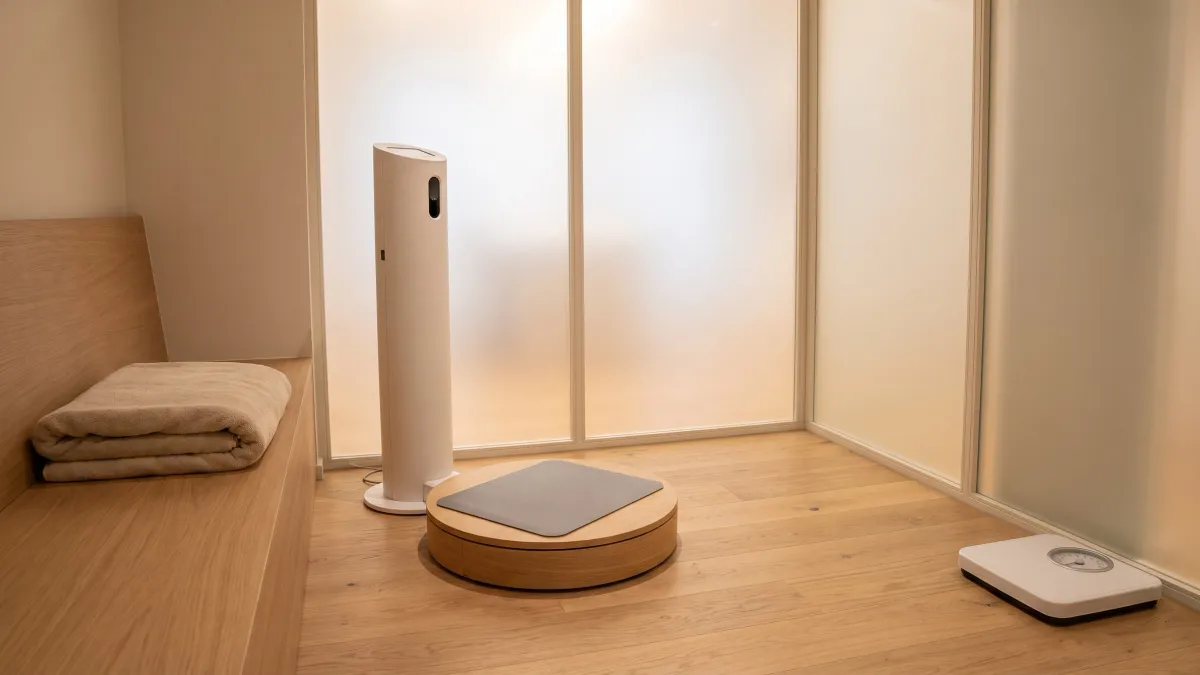
You stand on a turntable in a private room, in fitted clothing, while the turntable slowly rotates. The Styku scanner uses harmless infrared light to capture your shape. The whole scan takes about 35 seconds. It is non-invasive: no needles, no radiation and nothing touches you except the platform under your feet.
From that scan, the Styku 3D body scanning technology produces:
- Circumference measurements at the waist, hips, thighs and bust, taken the same way every time, which also shows fat distribution, meaning where you carry weight
- An estimated body fat percentage
- A 3D image of your body you can view and compare with earlier scans
From the body fat estimate, your provider can also estimate lean mass, which is the part of you that is not fat: muscle, bone, organs and water. That matters for your plan, because your provider uses lean mass to help set your daily protein target. You can read more about how protein targets work in our sample week medical weight loss meal plan.
What your body composition analysis shows
The real value of a 3D body scan for weight loss is seeing change you cannot feel from one week to the next.
Your shape, in 3D. Seeing your body in 3D, rotated and compared side by side with an earlier scan, shows changes in body shape that are hard to notice in a mirror you look into every day.
Inches, not just pounds. Circumference measurements show where you are losing. Many people lose inches at the waist before the scale reflects much change, and the report makes that measurable.
Body fat trend. The estimated body fat percentage, compared over time on the same scanner, helps show whether the weight you are losing is mostly fat. That is the goal: losing fat while protecting lean muscle mass.
Progress over time. One scan is a starting point, a benchmark for your health goals. The second and third scans are where the insights into your body composition come from, because now there is a trend to read. That kind of progress tracking turns vague weight loss goals into measurable results you can see.
For many patients this is the most motivating part of the program, and it supports overall wellness in a quieter way too: it replaces a number that can wreck your mood with a fuller picture. On a week when the scale is stubborn, seeing a smaller waist measurement and a lower body fat estimate is proof that the work is paying off.
Honest limits, and how a 3D scan compares to a DEXA scan
We would rather you trust the numbers than be oversold on them, so here is what a 3D body scan is and is not.
Body fat percentage is an estimate. A 3D scanner measures your outside shape with great consistency. It calculates body fat from that shape using equations, rather than looking inside your body. Every common method of calculating body fat, from a skinfold caliper to bioelectrical impedance analysis on a smart scale, is an estimate with some margin of error.
It is not a DEXA scan. DEXA (also written DXA), short for dual-energy X-ray absorptiometry, is a medical imaging test that uses a low dose of X-ray to measure bone density, and it can also measure fat mass and lean tissue by region. It is often used as a reference method in research and for checking bone mass and bone health. A 3D body scan does not use X-ray, does not measure bone density, and should not be treated as equally accurate. We do not offer DEXA, and we do not describe our scans as diagnostic.
The value is in comparison. Where a 3D scan shines is repeatability. Scanning on the same Styku scanner, under similar conditions, gives you a reliable way to track progress and see the direction of change. Comparing a Styku number to a number from a different machine at a gym or another office is not a fair comparison, so we focus on your own trend.
It does not replace your provider. A scan is one tool inside a medical weight loss program. Health risk, labs, medications and conditions such as high blood pressure are your provider's job, not the scanner's.
How often should you get a 3D body scan?
Body composition changes slowly. Fat loss and muscle changes take weeks to show up clearly, so scanning every few days mostly measures noise.
For most people, spacing scans several weeks apart, or scanning at milestones such as the start of a program, a plateau, or a change in your plan, gives the clearest picture. Ask at your consultation what schedule makes sense for your goals.
To keep your scans comparable, try to keep conditions the same each time:
- Scan at a similar time of day.
- Wear the same kind of fitted clothing.
- Keep hydration and meals similar beforehand, and avoid scanning right after a hard workout.
Scan, scale and tape measure: how they fit into weight management
You do not have to choose one. Each tool answers a different question, and together they give you more actionable health insights than any single metric.
| Tool | What it tells you | How to use it |
|---|---|---|
| Bathroom scale | Total body weight | Weigh at the same time, same conditions, and watch the weekly trend instead of single days |
| Tape measure | A quick waist check at home | Measure the same spot every couple of weeks |
| 3D body scan | Shape, circumferences, estimated body fat and lean mass | Scan every several weeks on the same scanner to see what the weight change is made of |
Think of the scale as the daily weather and the scan as the season. The scale can swing on a salty Tuesday. The scan, taken weeks apart, shows whether your body composition is really moving in the right direction.
BMI has its place in health screening, but it is just your weight compared with your height. It cannot tell muscle from fat, which is why two people with the same BMI can look and feel very different. A body composition assessment fills in that gap.
Inch loss and Invisa-RED
Because the Styku scanner measures circumference the same way every time, it is a natural fit for tracking inch loss, not just pounds.
That includes Invisa-RED laser body contouring, which we also offer at our Flint clinic. Invisa-RED is FDA-cleared, not FDA-approved, for the temporary reduction of the circumference of the waist, hips and thighs. It is not a weight loss treatment, and its results are measured in inches rather than pounds. Measuring the same areas the same way before and after a series of sessions gives you a clear, objective way to see your own change rather than relying on how your jeans fit. Results vary, and they last longer when you pair the treatment with the eating and activity habits of the weight loss program.
Common questions
Is a 3D body scan safe?
The Styku scanner uses harmless infrared light. There is no X-ray and no radiation exposure, and the scan takes about 35 seconds.
What is the difference between a DEXA scan and a 3D body scan?
DEXA uses a low-dose X-ray to look inside the body and measure bone density, fat and lean tissue. A 3D body scan uses infrared light to capture your outside shape and estimates body fat from it. DEXA is generally considered more precise for body composition. A 3D scan is quick and well suited to tracking your measurements and shape over time on the same scanner.
How accurate is a 3D body scan for tracking weight loss progress?
Circumference measurements are taken the same automated way every time, which makes them well suited to tracking change. Body fat percentage is an estimate, so focus on the trend across several scans rather than any single number.
How much does a Styku scan cost?
Styku scanning is priced separately from the free consultation, and we quote it before you scan, so there are no surprises. Ask about it when you book.
Is there a body composition scan near me in the Flint area?
Yes. We offer 3D body scanning in Flint, MI at 1448 W Hill Rd, Suite 1, right off US-23 at the Hill Road exit. We serve Flint, Grand Blanc, Fenton, Burton, Swartz Creek and Davison.
Getting started in the Flint area
If the scale has been running your mood, it may be time to measure what actually matters. At Body Trim Weight Loss Clinic, we start with a free consultation, review your health history and goals, and talk through whether a Styku 3D body scan makes sense as your baseline. From there, your provider can set your protein target and track your progress with real measurements instead of guesswork.
Call us at 810-600-6306 or book a free consultation.
This article is educational and is not medical advice. Body composition estimates from any scanner vary, and a 3D body scan is not a diagnostic test. Talk with a qualified healthcare provider before beginning any weight loss program or treatment, particularly if you manage a chronic condition or take prescription medication. Individual results vary.
This article is general information from Body Trim Weight Loss Clinic and is not a substitute for advice from your own provider. Individual results vary.